SOFTEL Around the World: Meet the Experts Behind Every Conversation
3 continents. 30 years. 4 offices. 8 languages spoken daily. That’s SOFTEL today — and most of what makes it work never shows up on LinkedIn.
Founded three decades ago, we’ve grown into a global team of contact-center experts across the Americas, EMEA, and APAC. Different cities, different time zones, different languages and local customs — but one shared craft: making sure every customer conversation lands the way it should, anywhere in the world.
The people behind that work rarely get the spotlight. We want to change that.
SOFTEL Behind the Scenes, our weekly series introducing the global experts who keep contact centers running seamlessly, continues. Each week you’ll meet a different colleague: what problem they solve, what they’ve learned from working in their region, and what most outsiders get wrong about modern contact centers.
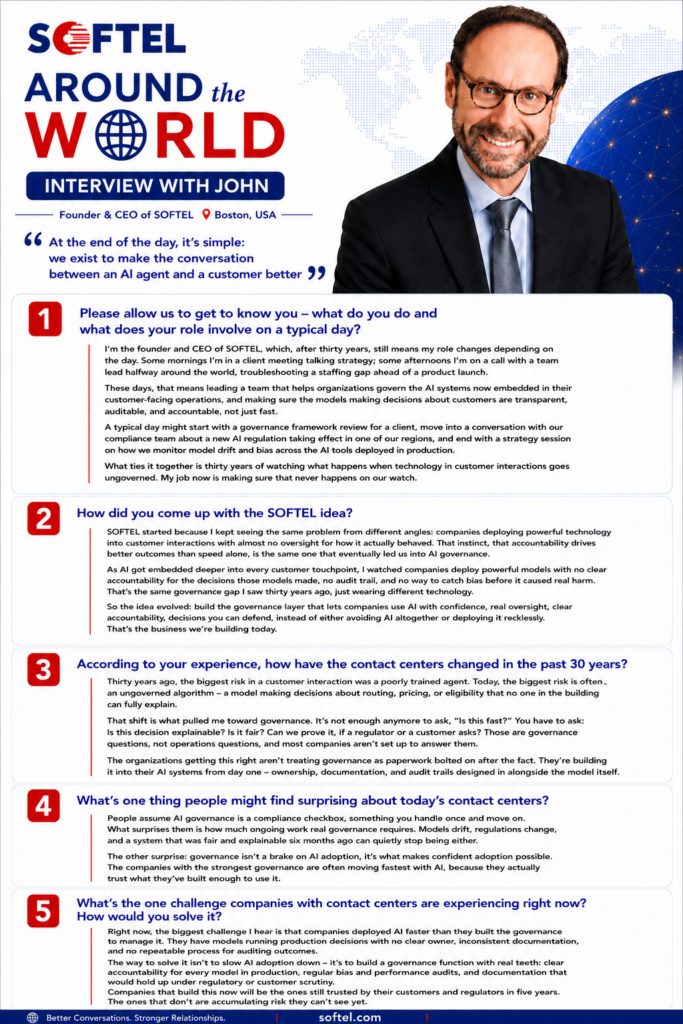
This week, we’re taking a trip back to where it all began. From Boston, USA, SOFTEL Founder John Cognata looks back on the company’s beginnings and the remarkable journey that has shaped SOFTEL over the past three decades.
Interview with John.
1. Please allow us to get to know you – what do you do and what does your role involve on a typical day?
John: I’m the founder and CEO of SOFTEL. which, after thirty years, still means my role changes depending on the day. Some mornings I’m in a client meeting talking strategy; some afternoons I’m on a call with a team lead halfway around the world, troubleshooting a staffing gap ahead of a product launch.
These days, that means leading a team that helps organizations govern the AI systems now embedded in their customer-facing operations, and making sure the models making decisions about customers are transparent, auditable, and accountable, not just fast.
A typical day might start with a governance framework review for a client, move into a conversation with our compliance team about a new AI regulation taking effect in one of our regions, and end with a strategy session on how we monitor model drift and bias across the AI tools deployed in production.
What ties it together is thirty years of watching what happens when technology in customer interactions goes ungoverned. My job now is making sure that never happens on our watch.
2. How did you come up with the SOFTEL idea?
John: SOFTEL started because I kept seeing the same problem from different angles: companies deploying powerful technology into customer interactions with almost no oversight for how it actually behaved. That instinct, that accountability drives better outcomes than speed alone, is the same one that eventually led us into AI governance.
As AI got embedded deeper into every customer touchpoint, I watched companies deploy powerful models with no clear accountability for the decisions those models made, no audit trail, and no way to catch bias before it caused real harm. That’s the same governance gap I saw thirty years ago, just wearing different technology.
So the idea evolved: build the governance layer that lets companies use AI with confidence, real oversight, clear accountability, decisions you can defend, instead of either avoiding AI altogether or deploying it recklessly. That’s the business we’re building today.
3. According to your experience, how have the contact centers changed in the past 30 years?
John: Thirty years ago, the biggest risk in a customer interaction was a poorly trained agent. Today, the biggest risk is often an ungoverned algorithm – a model making decisions about routing, pricing, or eligibility that no one in the building can fully explain.
That shift is what pulled me toward governance. It’s not enough anymore to ask, “Is this fast?” You have to ask: Is this decision explainable? Is it fair? Can we prove it, if a regulator or a customer asks? Those are governance questions, not operations questions, and most companies aren’t set up to answer them.
The organizations getting this right aren’t treating governance as paperwork bolted on after the fact. They’re building it into their AI systems from day one — ownership, documentation, and audit trails designed in alongside the model itself.
4. What’s one thing people might find surprising about today’s contact centers?
John: People assume AI governance is a compliance checkbox, something you handle once and move on. What surprises them is how much ongoing work real governance requires. Models drift, regulations change, and a system that was fair and explainable six months ago can quietly stop being either.
The other surprise: governance isn’t a brake on AI adoption, it’s what makes confident adoption possible. The companies with the strongest governance are often moving fastest with AI, because they actually trust what they’ve built enough to use it.
5. What’s the one challenge companies with contact centers are experiencing right now? How would you solve it?
John: Right now, the biggest challenge I hear is that companies deployed AI faster than they built the governance to manage it. They have models running production decisions with no clear owner, inconsistent documentation, and no repeatable process for auditing outcomes.
The way to solve it isn’t to slow AI adoption down — it’s to build a governance function with real teeth: clear accountability for every model in production, regular bias and performance audits, and documentation that would hold up under regulatory or customer scrutiny.
Companies that build this now will be the ones still trusted by their customers and regulators in five years. The ones that don’t are accumulating risk they can’t see yet.